
Affinity chromatography

درباره سایت
آخرین مطالب
- Isolation and Identification of Amino Acids, Vine and Carboxylic
- Isolation and Identification of Amino Acids, Vine and Carboxylic
- ازمایش 3 Making alcohol-derived data
- Alcohols
- alchool test
- Aldehyde & Ketons
- Isolation and Identification of Amino Acids, Vine and Carboxylic
- Identify alkene and alkyne, halide of aliphatic, Identifyand carbohydrates
- Affinity chromatography
امکانات وب
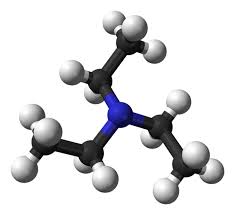
Amines are organic compounds and are considered to be components of the water (the color of the litmus lamp is blue), which includes a central nitrogen atom and one, two or three groups of alkyl with general formulas NR 3 _NHR 2 _NH 2 R They are called amine type 1, amine type 2, and amine type 3, respectively.



Amines are usually extracted from ammonia, which is replaced by alkylated hydrogens. The second type of amine play is more than the rest.
Amine function
Amines and other nitrogen-containing compounds are among the most abundant organic molecules. All amines have the character of the game (first and second type amines can act as acids), they form hydrogen bonds and act as a kernel in substitution reactions. So in many respects, chemistry is similar to that of alcohols and ethers. But there are differences in activity as electronegative nitrogen is less than oxygen.
Amines Application:
Many biological active compounds contain nitrogen. Many simple amines are used as drugs. Like morphine and codeine in the amine group. Other important amines are amino acids.
In addition to the use of amines in pharmaceuticals and the separation of enantiomers, there are various uses in the industry. Methamidamine (HMDA) is a commercially important amine. Which is the nylon industrial nylon material.
Solubility test
A compound that is insoluble in water and not in solution, but dissolved in 5% hydrochloric acid solution, is an amine. Aliphatic amines of type I, II, III, and aromatic amines are soluble in 5% soluble hydrochloric acid solution.
Identity Testing
* Hinsberg Test:
With the help of this test, one can identify the first, second and third type amines. This test is based on the assumption that the first and second type amines are combined with arsen-sulfonyl halides, producing n-sulfonamides. The product of these reactions is a sulfone amide of a first derivative (of the first type of amine) and of the two-substituted sulfonamide (of the second type amine). Sulphonamide is a substrate in solubility soluble solubility, but do not dissolve the two-sumed sulfonamide in the solution, because it does not contain acid. Therefore it can not form a salt in the open reaction. Third type amino acids lack amino acids, so they are not reactive in these conditions.
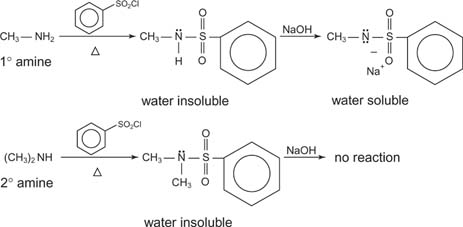
Description of experiment:
Add 0.6cc of liquid amine or 0.1 g of amine solid and 0.2 ml of benzene sulfonyl chloride (4 to 5 drops) and 5 ml of sodium hydroxide 10% D in a small test tube, closing the tube door and We shake 3 to 5 minutes.
Then remove the tube door and heat it for a minute while shaking it, then cool the tube and try it with litmus paper. If the alkaline environment is not present, we will pour more NaOH solution to play.
If a sediment or oily layer is formed, there may be two substitutions of the sulfone amide, and the amine is a second type amine. Separate the oily layer or the sediment with overflow and check its solubility in concentrated HCl. (Sulfonated amide is not soluble in concentrated HCl.) If dilution of the sediment or oily layer is not left, carefully add to the solution, add HCl and concentrate it with acid pH. If the precipitate is formed, it is due to the presence of single-sumed sulfoneamide. That is, the unknown is the first type of amine. If the above items are not observed, that is, there is no reaction, because of the presence of a third type amine.
Complication: Sulphonamide Some type I amines, insoluble sodium salts. This may be due to the mistake of the second type amine instead of the first one
Chemical Properties: Perform the following reaction
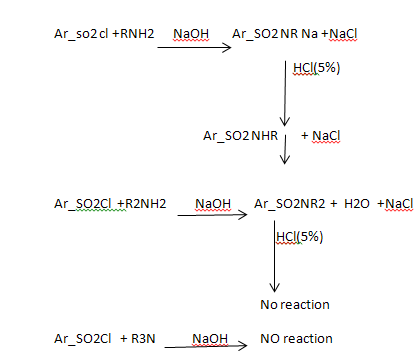
Physical Properties:
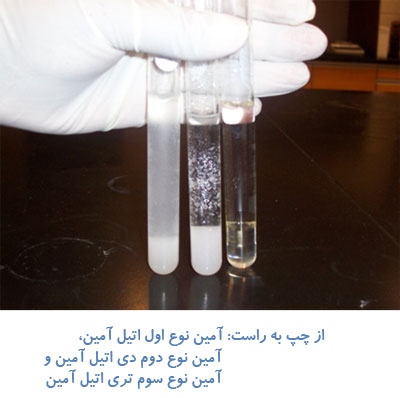
The first type of amine -------> is initially soluble and precipitates by pouring HCl.
The second type of amine is precipitated and is not solved in HCL.
Amine Type III: Oily substance formed and dissolved in HCl.
Test for aqueous solution of copper (ll) sulfate (Spot test):
One of the easiest ways that it can be used to identify amines is the use of copper (II) sulfate aqueous. The proximity of amines to this substance causes reactivity and often produces complexes from blue to blue-blue.
The production of a complex and, as a result of the formation of color, is the reason for the test being positive.
Physical Properties: Creating a Blue Complex
Amino acid
Amino acids are the polyethylene and protein unit and, in fact, one of the building blocks of living organisms. According to a strong theory of amino acids, with the massive meteor shower rains encountered during the formation of the earth to the surface of the earth and the introduction of more complex molecules into living beings.
The amino acid in chemistry is referred to any molecule that contains amino functional groups and carboxylic acid .
Identification of amino acids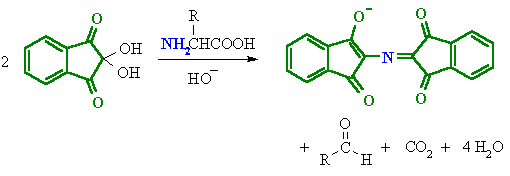
Ninhydridine Test:
physical propertis of nin hydrin
Amino acid
Amino acids are the polyethylene and protein unit and, in fact, one of the building blocks of living organisms. According to a strong theory of amino acids, with the massive meteor shower rains encountered during the formation of the earth to the surface of the earth and the introduction of more complex molecules into living beings.
The amino acid in chemistry is referred to any molecule that contains amino functional groups and carboxylic acid .
Identification of amino acids
Ninhydridine Test:
physical propertis of nin hydrin
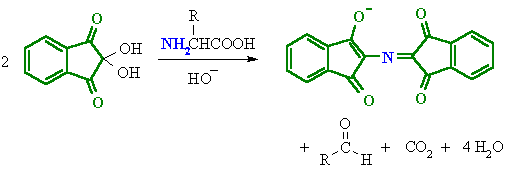
In this test, the compound called ninhydrin is reacted with amino acid. In the event of a collision and adjacency of these two, amine and carboxylic amino acids are released. And the amino acid itself forms in the form of an aldehyde compound (CHO_R) . And Nine Hydrine turns into a substance called Hydrine Duntin.
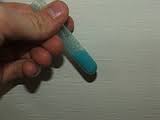
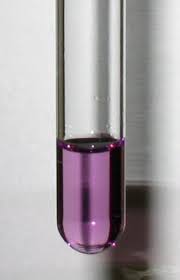
Ninhydrin reacts with 19 types of amino acids in the protein structure and produces a blue compound that is almost purple due to the heat. In other words, it can be said
Nin Hydrin + All Amino Acids = Purple Complex
Different amino acids at different times form with ninhydrin, which is directly related to the acidic structure of the amino acids.
In this process, the amino acids divide the two ninhydrin molecules through the nitrogen atom, and the amino acid itself is separated as an aldehyde. In order to add amino acid to ninhydrin, this can be done through the free electron pair of nitrogen-amines.
In the next step, the removal of a CO 2 molecule occurs, and the R group binds to nitrogen to ninhydrin. It seems that at this stage, as well as the stage of separation of aldehyde, the difference in amino acids is determined at the time of coloring. The different tendency of hydrocarbon groups in different amino acids affects the removal rate of carbon dioxide molecules.
Glycine, which is a small amino acid, loses carbon dioxide, due to its stable structure and lack of R. The lack of glycine-restricting spatial constraints has turned into an amino acid that performs ninhydrin well.

The presence of benzene ring in the structure of tryptophan and phenylalanine and the resonance effects of this ring in the stability of the aldehyde-excreted group also make the ninhydrin test well.


Due to the absence of free amines, proline does not allow for free bonding with ninhydrin. Looking at the proline structure, we find that this type of amine enclosed in the five-membered circle limits the freedom to add nitrogen to ninhydrin. The color obtained from Proline in the Ninhydrin Yellow test.
Third- type amines give a negative answer to the Ninhydrin test !!
Proline + Nin Hydrin → Yellow

method:
1-2 cc amino acid solution + several drops of ninhydrin solution → 5 minutes in bin marie wax
All amino acids give a positive answer. Purple
Proline → Yellow
Test theory
Carboxylic acids
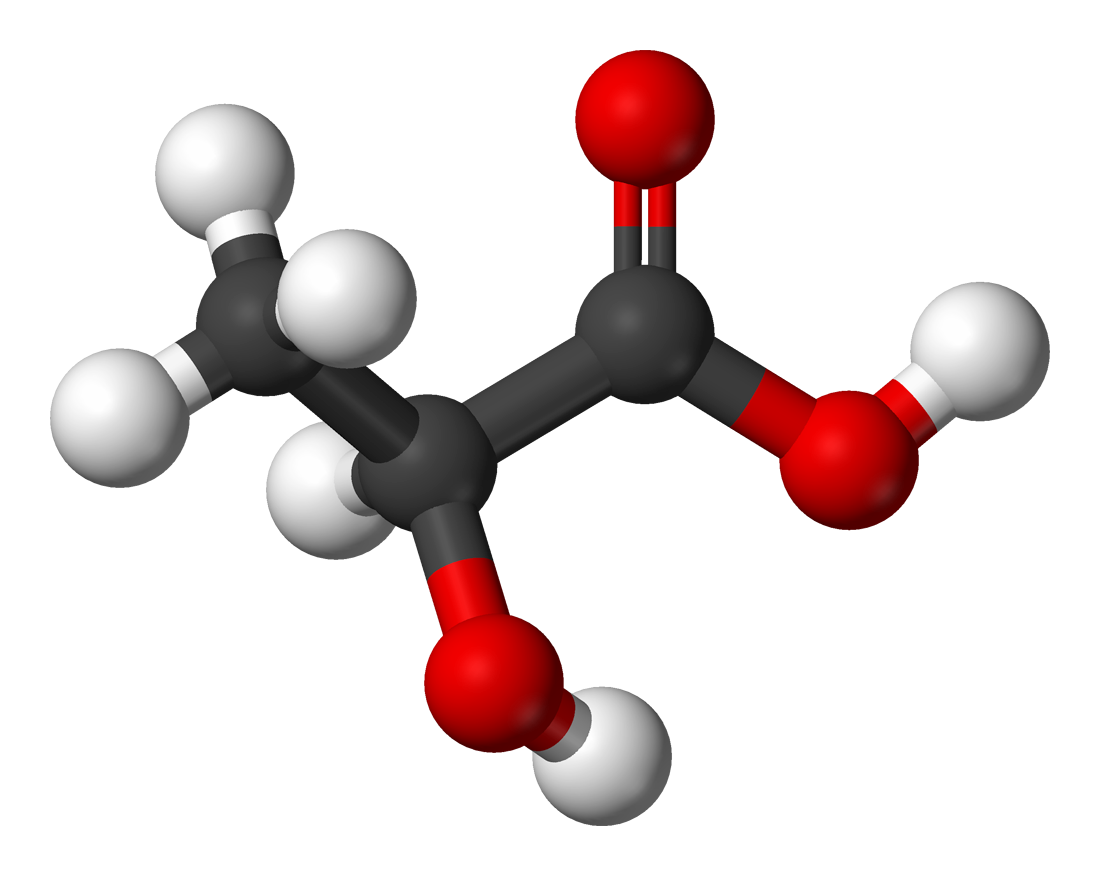
Carboxylic acids are known for their essential oils due to their essential oils.
Physical Properties of Carboxylic Acids
Carboxylic acids are light-weight liquids and their boiling temperatures increase as usual with increasing molecular mass, but the increase in their melting temperature does not change uniformly with molecular mass. The acids in which their carbon numbers are paired is higher than their melting temperatures, with acids similar to those of individual carbon.
The boiling point of the acids is higher than that of the molecules of the same molecule. Principally, the carboxyl agent increases the boiling temperature of the compounds more than any other factor.
The high boiling point of acids indicates strong hydrogen bonds between the molecules of acids.
The most important property of carboxylic acids is their acidity. The acids that do not dissolve in water dissolve in sodium bicarbonate solution in the form of sodium carboxylate. In this way, these compounds can be recognized.
Chemical Properties of Carboxylic Acids
Chemical properties of carboxylic acids include the reaction of the group COO and the effect of this group on the rest of the molecule.
Identification of carboxylic acids
Identification of these compounds is mainly due to their solubility properties, which are soluble in sodium sulphate and sodium bicarbonate solution.
pH of aqueous solution:
If the composition is soluble in water, it's easy to check pH using pH paper. The pH of the carboxylic acid is low.
Sodium Bicarbonate:
If the compound is dissolved in a 10% sodium bicarbonate solution, it is acidic if it forms carbon dioxide gas (CO 2 ) gas bubbles visible.
method:
Dissolve 0.2 g of the acid sample in 50 to 100 ml of aqueous ethanol solution. Titrate this solution with sodium hydroxide 0.1 normal.
The molecular weight of an acid can be calculated by multiplying the neutralization value in acid capacity. Acid is determined using molecular weight.
برچسب:
نویسنده: مانی افشاری