
Affinity chromatography

درباره سایت
آخرین مطالب
- Isolation and Identification of Amino Acids, Vine and Carboxylic
- Isolation and Identification of Amino Acids, Vine and Carboxylic
- ازمایش 3 Making alcohol-derived data
- Alcohols
- alchool test
- Aldehyde & Ketons
- Isolation and Identification of Amino Acids, Vine and Carboxylic
- Identify alkene and alkyne, halide of aliphatic, Identifyand carbohydrates
- Affinity chromatography
امکانات وب
Aldehyde & Ketones
In compounds having a carbonyl functional group, if the carbonyl group is substituted with hydrogen atoms or alkylated groups, they are called aldehyde (RCHO) or ketone (RCOR). The chemistry of these compounds, in fact, is the chemical group of carbonyl derivatives. Identification of these compounds is possible by the characteristic reactions of the carbonyl functional group. To identify aldehydes and ketones there are various tests that can be used to test 2 and 4 - di nitrofenylhydrazine, chromic acid test, iodoform test, talenz test, fushin test and benedic test.

2,4dinitrofenylhydrazine
This test is the most prominent test for the detection of aldehydes and ketones. Aldehydes and ketones with a reagent 2 and 4-di-nitro-phenyl hydrazine form a yellow to orange deposit (red).
Aldehyde and ketones that have a carbonaceous conjugate and are unsaturated are orange (red), i.e. with higher wavelengths
In this nuclear reaction, nitrogen friendliness makes the reaction easy to accomplish
This test, in addition to identifying aldehyde or ketone, is also one of the derivatives of these compounds, since the formed sediment is polarized, flattened and heavier than aldehyde and ketone
Chemical properties
reacts with the carbonyl group of aldehydes and ketones

Physical properties
The formation of a yellow, orange or orange-red precipitate
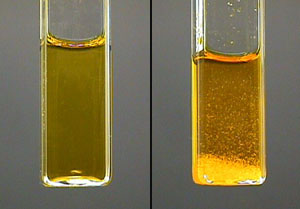
a negative test (left) and a positive test (right)
Complication errors
Some Allyl Derivatives Alcohols may be converted to oxygen by air to ketones and ultimately produced in the form of a sediment reagent. For example: ciamines-di-phenyl-krananol
So in general, if the alcohol is easily oxidized by oxygen and converted to aldehyde and ketone, then it may be possible for us to make a mistake in this test.
Vitamin A1 is also one of the compounds that produces this sediment reagent.
Some ketones do not create sediment with this reagent. For example: octinum ketone-dimethyl ketone, which produces yellow or orange-yellow sediment
Mechanism

Sodium bisulfite test
Bisulfite: Most of the aldehydes make up this milky sediment test. Getting this milky product requires a lot of care, and you must fully comply with the stated amounts to achieve the desired result
Chemical properties
NAHSO3 Because nuclophil is not very strong, only hydrogen sulfide can form in the carbonyl group with aldehyde hydrogen. Some ketones that do not have much space for interference may also respond to this test

Physical properties
Creates a milky dye
Complication errors
This test is susceptible because sodium bisulfite (the reagent) dissolves in water, so it may not be possible to create the product's milk color in water, or it may not be possible to dissolve the aldoide that we want to test in water or the sodium sulfite product that exists. It is completely soluble in water. In none of these states easily this test does not work.
Solution: In order to minimize the mistake, make a blue solution of alcohol so that the sodium sulfite can precipitate slightly, but care should be taken to remove the sediment by decanting or smoothing, so that it does not pass into the aldehyde container, that is, with saturated solution Sodium bisulfite alcohol test.
There may be compounds that produce the same result without causing the aldehyde or ketone, causing the dye to appear
Tollen’s Test
All aldehydes and light ketones respond positively to this test. In other words, the Talens test is used to detect aldehydes from ketones.
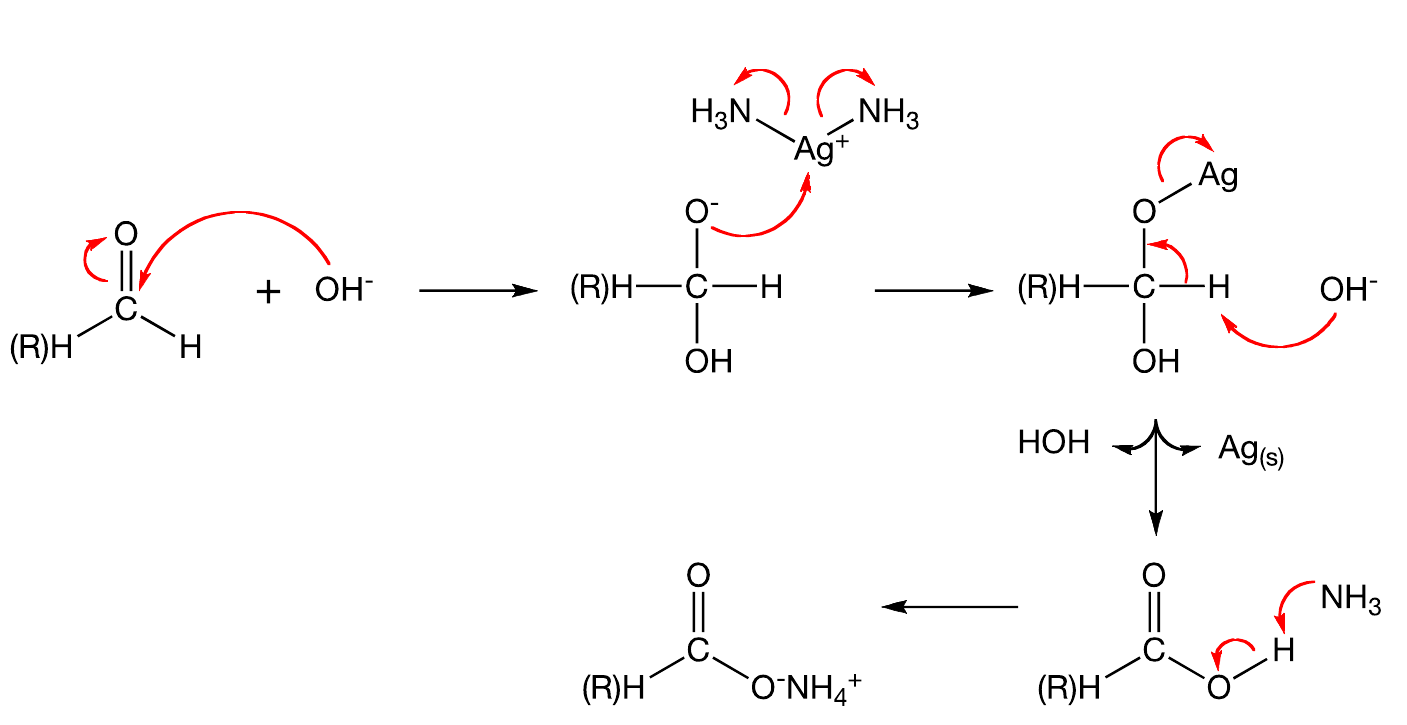
Aldehydes are tested in response to the Thalene reagent (Tollens) producing a silver mirror in the tube wall
Chemical properties
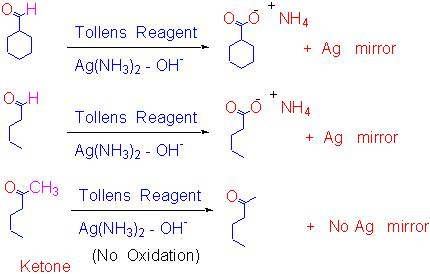
Physical properties
The silver deposit on the wall of the test tube is the result of silver oxide
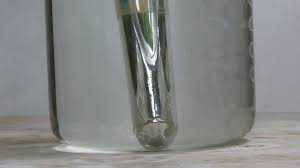
Complication errors
Some simple ketones, such as acetone and methyl ethyl ketone, also respond positively to this test
If the hydroxyl ion is high, the hydroxide complex is formed and prevents the reaction.
If you pour a lot of ammonia, produce the Ag (NH3)4 complex and do not react with aldehyde
Mecanism
Benedict's test
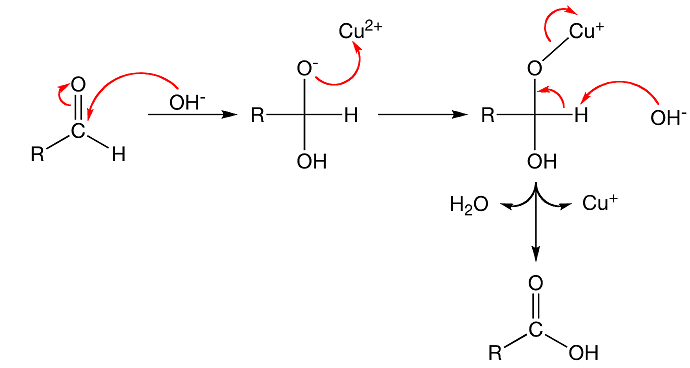
Reporter Benedict is a well-known reporter named Stanley Rossiter Benedict. Which is used to identify aliphatic (non-aromatic) aldehydes lacking sulfur and alpha-hydroxy ketones. In the following figure, you can see the reaction of an aldehyde and an alpha-hydroxy ketone with Benedict's recipe
Chemical properties
RCHO + 2Cu(citrate)2+ → RCOOH + Cu2O(s) + H2O
Physical properties
Creates a red, yellow, green color that depends on the amount of sugar

Complication errors
Any regenerator that can convert bivalent copper to a copper is a color that creates complexity in this test
For example: phenylhydrazines
Copper sulfate is not dissolved in organic environments because it is an inorganic salt
To solve this problem, we introduce an organic anion (sodium citrate) that can replace copper cation and sit instead of sulfate. Because it dissolves itself in the organic environment, copper can also enter the organic environment
To improve this, we can make the environment alkaline to increase the chance of copper sulfate in the organic environment
Mechanism
Schiff test
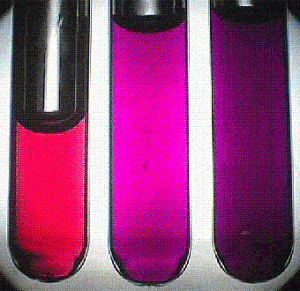
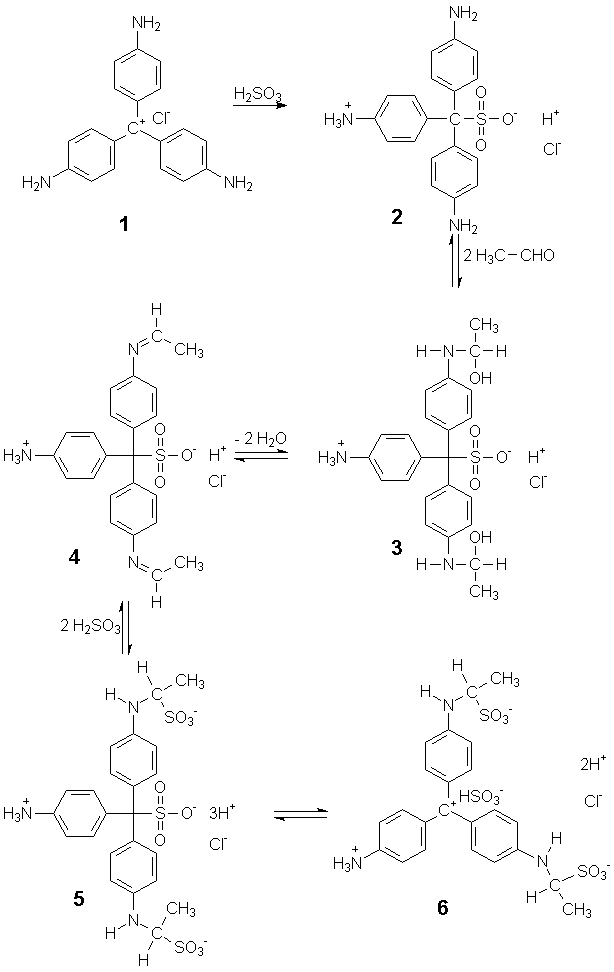
The Schiff test named after is a chemical test for the detection of aldehyde. An unknown sample is added to the decolorized Schiff reagent and when aldehyde is present a characteristic magenta or purple color develops. The Schiff reagent is the reaction product of Fuchsine and sodium bisulfite. Human skin also contains aldehydes and gets stained as well. Hugo (Ugo) Schiff (* 1834 in Frankfurt am Main, †1915 in Florence) was a German Chemist. ... In chemistry, a chemical test is qualitative or semi-quantitative procedure designed to prove the existence of a chemical compound or chemical group with the aid of a specific reagent. ... An aldehyde is either a functional group consisting of a terminal carbonyl group, or a compound containing a terminal carbonyl group. ... Magenta is a color made up of red and blue light. ... Fuchsine Fuchsine, fuchsin, rosanilin, or rosaniline hydrochloride is a magenta dye with chemical formula C19H17N3·HCl. ... Sodium hydrogen sulfite or sodium bisulfite is a chemical compound with the chemical formula NaHSO3
Chemical properties
Physical properties
Formation of a purple solution that represents aldehyde
Complication errors
In this test the reagent should not be heated, and the solution tested should not be alkaline. When the test is used on an unknown, a simultaneous test on a known aldehyde and a known ketone should be performed for comparison
Note: With benzaldehyde the pink colour developes slowly
Mechanism
Identification of ٍٍEsters
Physical and Chemical Properties of Esters
1) The boiling temperature of the ethers is much lower than the boiling point of the corresponding acids. Reason: With the substitution of the RO group - with HO - the possibility of hydrogen bonding is eliminated. Thus, the molecules of the ester are simple molecules.
2) Esters are more stable than heat in the heat.
3. Due to the lack of hydrogen bonding of esters in water, organic solvents are better than acids.
4. Starches are considered to be the best organic solvents.
5. Styles are aromatic compounds and most fruits are found in essential oils
Preliminary testing
Dissolve 4 drops of unknown liquid in 3 ml of water or ethanol and add 3 to 2 drops of 5% friction chloride solution in water
Physical property
If the primary color does not intensify, then the negative is negative and we can test hydroxamid. But if the color is orange, red, blue, purple, purple, green or red, then the test is positive and the hydroxamid test is useless
Hydroxamic acid test
R-CO-OR' + H2N-OH -> R-CO-NH-OH + R'-OH
Esters react with hydroxylamine in the presence of sodium hydroxide to form the sodium salt of the corresponding hydroxamic acid. On acidification and addition of ferric chloride the magenta-coloured iron (III) complex of the hydroxamic acid is formed
It is always advisable to ensure that an unknown compound does not give a colour with iron (III) chloride before carrying out the hydroxamic acid test
Physical property
The color of the red solution is red

Chemical properties
When the esters are heated with hydroxylamine, they converge to the hydroxamic acid
Hydroxamic acids form stable and colored complexes with ionic ferric
complication errors
1. A number of acids are tested positive. 2. Initial Nitro Compounds and Compounds, Amides A number of amides and more nitriles and aldehydes are hydrogen-free alpha to test. 3. Positive test for amide is soluble in red, the negative test is yellow and brown is brown containing sediment. 4. The basic test must be performed before the main test. If you change color with ferric chloride, the main test can not be done because it may be in the impurities that react with the ferric chloride and give it a red color
Mechanism

The links used in the blog
llege.edu
guide.co.uk
+ نوشته شده توسط فاطمه رجبی و مهرناز مرتضوی ها در شنبه ششم آبان ۱۳۹۶ و ساعت 12:34 |
برچسب:
نویسنده: مانی افشاری