
Affinity chromatography

درباره سایت
آخرین مطالب
- Isolation and Identification of Amino Acids, Vine and Carboxylic
- Isolation and Identification of Amino Acids, Vine and Carboxylic
- ازمایش 3 Making alcohol-derived data
- Alcohols
- alchool test
- Aldehyde & Ketons
- Isolation and Identification of Amino Acids, Vine and Carboxylic
- Identify alkene and alkyne, halide of aliphatic, Identifyand carbohydrates
- Affinity chromatography
امکانات وب
Alcohols
Alcohols are classified into three types of type I, type II or type III, depending on the type of carbon bonded to the hydroxyl group (OH)
The carbon atom of the first and second types of alcohol, in contrast to the third type of alcohol, is subject to oxidation. In order to oxidize the alcohols, it is necessary to have a carbon atom attached to the hydroxyl agent, at least one hydrogen atom. From the oxidation of the first type of alcohol, first, aldehydes are produced, and then the acid is produced and, by oxidation, second-order alcohols only become ketones. Third-grade alcohols do not participate in oxidative reactions
On the other hand, type III alcohols produce more stable ions (carboxytones) with the loss of the OH functional group. Carboxyhounds are positive ions that alkylated electron substitutions, by stabilizing the positive charge, increase their stability and longevity. Thus, type 3 alcohols produce more stable carboxyates
Physical Properties of Alcohols
The general formula for alcohols is R_OH in which R is an alkyl or alkyl group.
The general formula is a non-ring CnH2n + 1 simple alcohol.
It may be an open or circular chain; it may have a halogen atom, more hydroxyls, or one of many other groups that are present in organic chemistry
Solubility
Due to the fact that the bond between the alcohols, such as water, is a hydrogen bond, dissolves to any extent in water. Also, due to the fact that the alcohols, on the one hand, have an organic part and, on the other hand, a group of hydroxides, also dissolve many organic materials.
Alcohol and phenol can be considered as a derivative of water in which one of the hydrogen hydrogens has been replaced by an organic group: H-O-H compared to R-O-H or Ar-O-H
Na test
One of the basic properties of the hydroxyl group is the formation of a hydrogen bond and the chemical exchange of hydrogen. Hydrogen metal (especially newly cut samples) easily reacts with the hydroxyl group and releases hydrogen
Hydrogen-reactive compounds in the reaction with sodium can liberate their hydrogen
This test is suitable for hydrocarbons that are easily removable in neutral compounds.
In other words, nitrogen or sulfur-bound hydrogens respond positively to this test.
The acetylene compounds are also reacted with sodium. But the hydrogen gas does not show up, because at the same rate as hydrogen, it enters an increasing reaction at the same speed of hydrogen with double bonds.
Sodium is a good test for the detection of active hydrogen in nonionic ionizing substances, otherwords, for SA ̦ A2 ̦ A1 and S2 groups, it is not a suitable method
Details of the reaction
If a small piece of sodium is dropped into some ethanol, it reacts steadily to give off bubbles of hydrogen gas and leaves a colourless solution of sodium ethoxide, CH3CH2ONa. Sodium ethoxide is known as an alkoxide
Mechanism


Physical properties
Hydrogen gas release
Chemical properties
Hydrogen bonds to electronegative atoms
Complication errors
We need to make sure that the agent group is active because it may lack a functional group but will respond positively to the test.
Test tubing is not dry.
The presence of impurities containing active hydrogen that provokes a positive test error
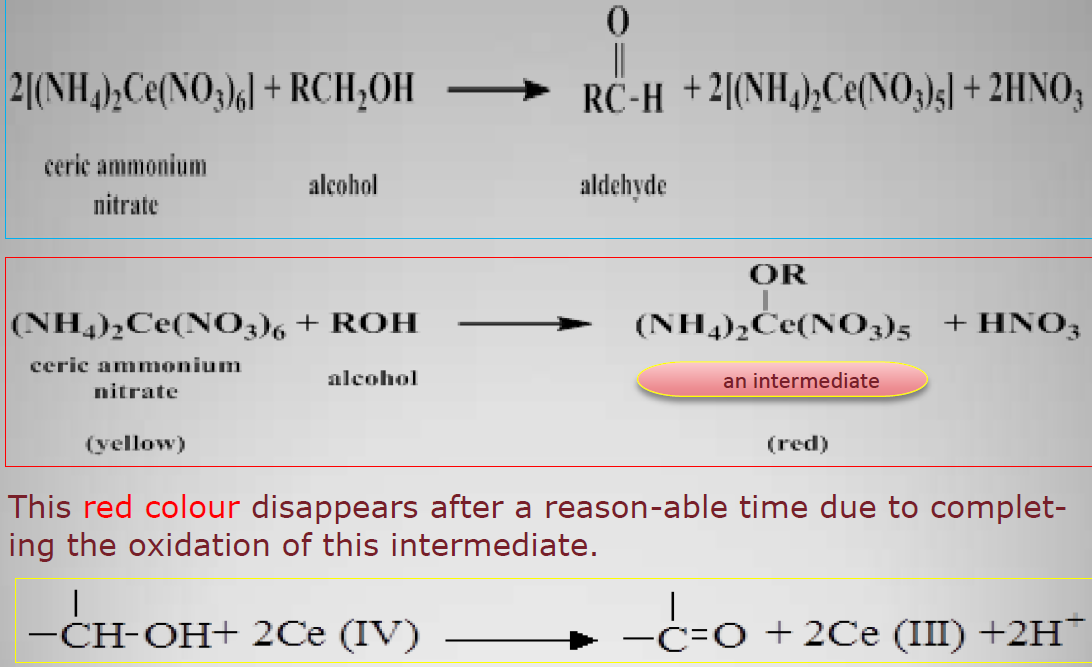
Ceric ammonium nitrate test
Translation errorThis color is discolored depending on the type of alcohol over a certain period of time.
The milking time is used to completely displace alcohol in the identification.
For example, methanol is dislodged in seven minutes and Alilic alcohol in six minutes.
The test should be carried out at room temperature (25 to 20 C), since many compounds are oxidized by cerium (IV) at higher temperatures.
Mechanism
Physical properties
Change the color of yellow to red
Chemical properties
Oxidation
Converts Ce + 3 to Ce + 4 and forms a complex
[NH₄)₂Ce(NO₃)₆ + RCH₂OH → [Alcohol + Re)
[complex] → RCH₂O(radical) + (NH₄)₂Ce(NO₃)₅ + HNO₃
RCH₂O + (NH₄)₂Ce(NO₃)₆ → RCHO + (NH₄)₂Ce(NO₃)₅ + HNO₃
Complication errors
Ring-amines and amine hydrochlorids may also be oxidized with the ammonium nitrate oxide reagent and produce or deposition
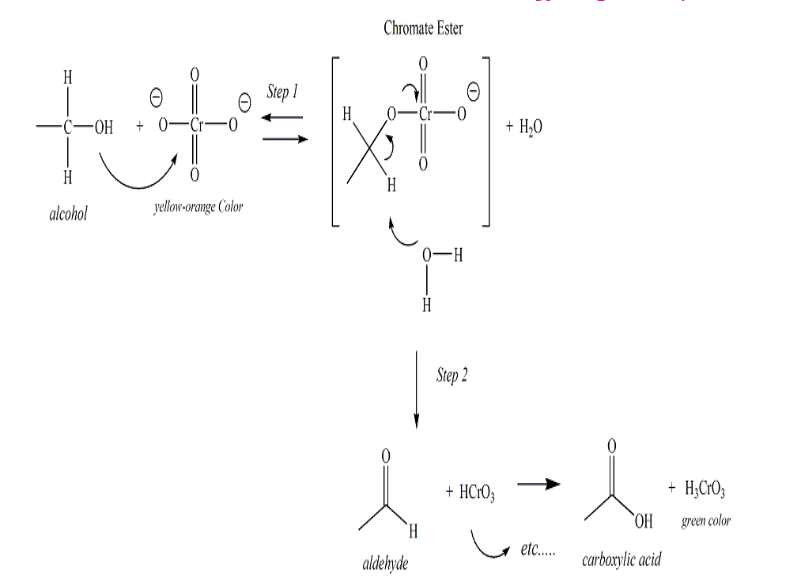
Jones test
This reaction is used to identify and detect first and second type alcohols of type III alcohols, and is based on the reduction of chromium (VI) yellow to orange to chromium (III). The alcohol is oxidized by this reaction. The color change of the reaction from orange to green is a positive response to the test. The first and second types of alcohol are converted to carboxylic acid and ketones, respectively, by the reaction. -It should be noted that first-type alcohol oxidation is first converted to aldehyde and then to carboxylic acid, but oxidation is stopped in the case of second type alcohols producing ketones.
Type I and II alcohols respond positively to chromic acid test (Jones reagent), but third-grade alcohol does not respond positively to this test
The aldehydes also respond positively to the chromic acid test (Jones reagent)
Mechanism
Physical properties
Change the red to green color
Chemical properties
Oxidation
Complication errors
This test is very fast, if more than 2 seconds long, other compounds may be involved in the green life. These compounds may include olefins, amines, ketones, anols, or phenols
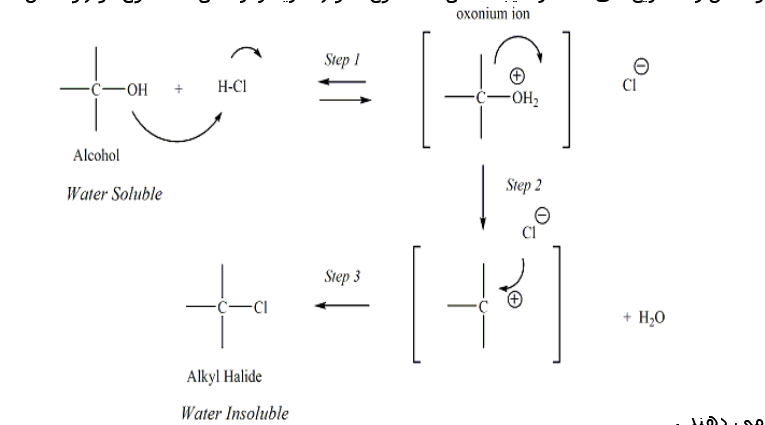
Lucas test
Lucas test for the detection of type III alcohols and alkali from the first and second type alcohols. This test is based on the reaction of alcohols with a mixture of hydrochloric acid and zinc chloride (Lucas reactor), which is a product of alkyl chloride, which is An insoluble layer. Type I alcohols do not react at room temperature with the Lucas reagent, and therefore their solubility is easy to see. Second-class alcohols respond slowly to Lucas's test, so that the test is considered to be negative. But third-grade alcohols, benzyl alcohol and allyl, react immediately. This reaction is mechanically a component of the SN1 reactions, which proceeds ionically. The cloudy environment is a positive reason for the reaction
Mechanism
Physical properties
Non-solubility of the reaction product due to the conversion of alcohol to alkaline halide R_X (oily seeds on the surface of solution) in insoluble aqueous medium and the formation of an organic phase
Chemical properties
Substitution - Cl instead of OH
+ نوشته شده توسط فاطمه رجبی و مهرناز مرتضوی ها در دوشنبه بیست و چهارم مهر ۱۳۹۶ و ساعت 22:44 |
برچسب:
نویسنده: مانی افشاری