
Affinity chromatography

درباره سایت
آخرین مطالب
- Isolation and Identification of Amino Acids, Vine and Carboxylic
- Isolation and Identification of Amino Acids, Vine and Carboxylic
- ازمایش 3 Making alcohol-derived data
- Alcohols
- alchool test
- Aldehyde & Ketons
- Isolation and Identification of Amino Acids, Vine and Carboxylic
- Identify alkene and alkyne, halide of aliphatic, Identifyand carbohydrates
- Affinity chromatography
امکانات وب
Specific identification tests are not detected by chemical means. Undertakings do not show in their inadequate and unconventional environment their physical attributes for identification.
The alkene group is a carbon-carbon double carbon bond. Therefore, in order to identify an unknown alkanical compound, it should be shown that the ordinary reactions of the carbon-carbon double bond are performed. Due to the large number of such reactions, this may seem easy.
If possible, we select a reaction as an identification test that can be done quickly and easily and can lead to a visible change. We will select a test, which will require a few minutes and several test pipes, a test in which the color will be created or destroyed, or the bubbles will come out, or the sediment will be formed or dissolved
Chemical properties
Bromine will add to the carbon-carbon double bond of alkenes to produce dibromoalkanes and with alkynes to produce tetrabromoalkanes. When this reaction occurs, molecular bromine is consumed, and its characteristic dark red‑brown color disappears if bromine is not added in excess. The rapid disappearance of the bromine color is a positive test for unsaturation
The test is not unequivocal, however, because some alkenes do not react with bromine, and some react very slowly. In the case of a negative test, therefore, the potassium permanganate test should be performed
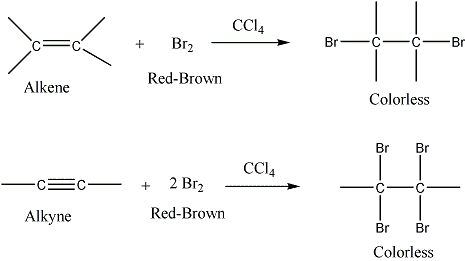
Physical Properties
Colorless ambient reaction
Bayer test
A second qualitative test for unsatuxadration, the Baeyer test, depends on the ability of potassium permanganate to oxidize the carbon‑carbon double bond to give alkanediols or the carbon-carbon triple bond to give carboxylic acids
The permanganate is destroyed in the reaction, and a brown precipitate of MnO2 is produced. The disappearance of the characteristic color of the permanganate ion is a positive test for unsaturation. However, care must be taken, since compounds containing certain other types of functional groups (for example, aldehydes, containing the --CH=O group) also decolorize permanganate ion
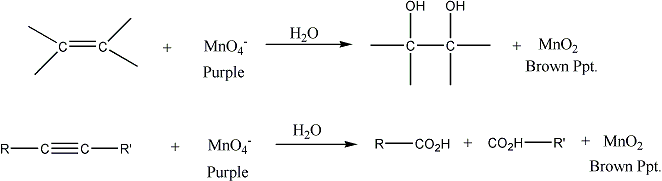
Physical properties
Creation of brown color
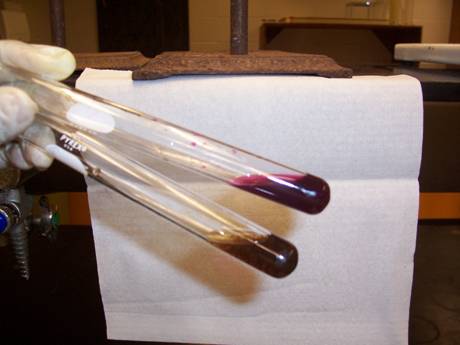
Complication errors
Water insoluble compounds should be dissolved in ethanol, methanol, or acetone
Often, the brown precipitate fails to form and the solution turns reddish-brown
Easily oxidized compounds give a positive test: a) Most aldehydes give a positive test. b) Formic acid and its esters give a positive test
Alcohols with trace impurities give a positive test
Phenols and aryl amines give a positive test
Carbonyl compounds which decolorize bromine/methylene chloride usually give a negative test
Identify halide of aliphatic
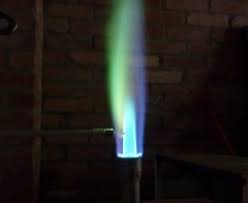
beilstein test
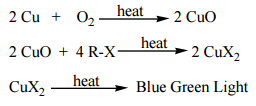
The presence of bromine, chlorine or iodine in organic compounds can be detected by the Beilstein Test. This test depends on the production of a volatile copper halide (CuX2 ) produced when an organic halide is strongly heated with a copper oxide. The copper halide will give off blue-green light when excited in the high temperature of a burner flame. This test is extremely sensitive and a positive result should always be confirmed by other methods
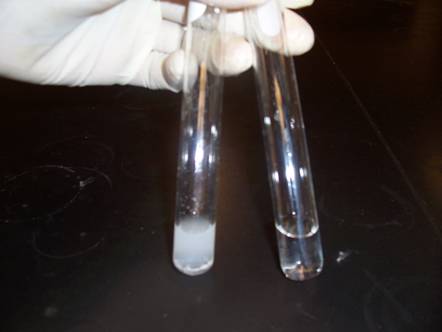
AgNO3 in Ethanol
Water-soluble compounds respond to this test immediately; RNH3X and [ROR] X
Insoluble compounds, however, are divided into three groups:
1) Those which include: R3CCl, R1, RCHClOR, RCHBrCH2Br, RCH = CHCH2X
2) heat-boiling ones. Such as: R2CHCl, RCH2Cl, RCHBr2
3) Those who do not react under any circumstances. Like vinyl halide CH2 = CHX and chloroform and aryl halide
Chemical properties
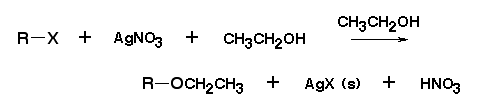
If a compound is known to contain a halogen (bromine, chlorine, or iodine), information concerning its environment may be obtained from observation of its reaction with alcoholic silver nitrate. The overall reaction is shown in the following equation
Ethanol
RX + AgNO3 ---------------> AgX + RONO2
Such a reaction will be of the SN1 type. Alkyl bromides and iodides react more rapidly than chlorides, and the latter may require warming to produce a reaction in a reasonable period
Complication errors
The time and temperature required to form the solid salt can vary widely
Identify of Aromtic hydrocarbons
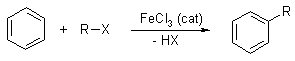
Friedel crafts
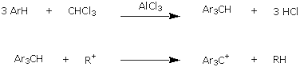
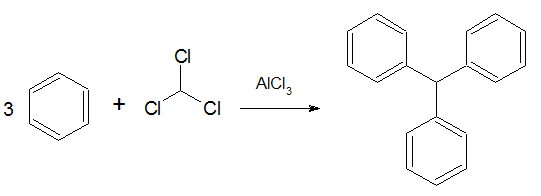
In the Friedel Kraft test, we first create an electroneutropic medium in the environment and then react it with a compound that is rich in electrons.
Compounds are rich in electrons, benzenes, or benzene derivatives. Benzene compounds have a particular stability due to their aromatics, and, unlike alkenes, do not have the desire to perform incremental reactions, and instead of electronegative settling reactions They do
In this test, the benzene derivative used is toluene, a methyl group attached to a benzene ring.
The methyl group activates the benzene group, so it guides the ortho and para positions on benzene
Physical properties
benzene:red orange
ArylHalydes:orange to red
Naphtalene:blue
biphenyl:purple
Phenanthrene:purple
Anthracene:geeen
Complication errors
Aromatic esters, ketones, amines, other compounds containing nitrogen, and oxygen may also be blue or green
Identify of carbohydrates
Molish test
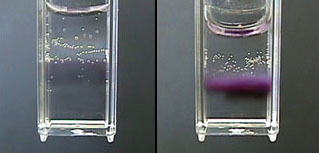
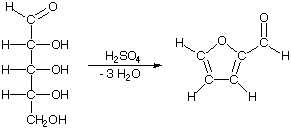
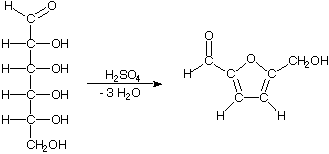
All sugars, such as oxidants or reducing agents, respond positively to this test, which is done in the vicinity of an acid. In the test tube, a two-phase system is formed that has a purple ring between the two phases. The reagent used in this reaction is alpha-naphthol in ethanol
Physical properties
Create a purple colored ring
Chemical properties
Complication errors
The reactor should be used in the test to be as large as possible. High use results in an error
Barfoed's test
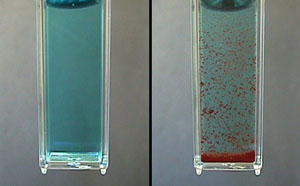
Barodate test (only for monosaccharides): This test is used to detect monosaccharides from regenerative disaccharides. Only if monosaccharides respond positively to this test because of the recovery of sugars in the weak acid environment and the duration of heating
Physical properties
Create reddish deposits
Chemical properties
Reduction of monosaccharides with copper ion in solution to form a carboxylic acid and red copper (I) deposits oxidize over three minutes. Reducing the diastereose is the same reaction, but it does so more quickly

Refrences
برچسب:
نویسنده: مانی افشاری