
Affinity chromatography

درباره سایت
آخرین مطالب
- Isolation and Identification of Amino Acids, Vine and Carboxylic
- Isolation and Identification of Amino Acids, Vine and Carboxylic
- ازمایش 3 Making alcohol-derived data
- Alcohols
- alchool test
- Aldehyde & Ketons
- Isolation and Identification of Amino Acids, Vine and Carboxylic
- Identify alkene and alkyne, halide of aliphatic, Identifyand carbohydrates
- Affinity chromatography
امکانات وب
Thin Film Chromatography (TLC):
Thin-layer chromatography is a type of , in which thin-film plates are used and the position of the components on the plate is determined. The particles on the layer should be large and compact and small. The quaternary is often made up of , which is used to separate hydrophilic molecules such as carbon hydrates , amino acids , and
Initially, chromatographic plates are required, ie, the gravity is distributed as a thin layer of uniform thickness on an inert rigid support. Glass sheets are commonly used, but there are other methods. Solid adsorbent in the form of fine powder with water, and sometimes with an escaping liquid , in the form of dough, and distributed by a commercial player or a simple home-grower or even by hand. It is also possible to prepare the layer using the method of spraying or dipping.
The plate is dried and heated at about 100, pre-set, activate it. Place a solution of the sample in a volatile solvent with a pipette or syringe on the screen. When the dried stain leaves the plate perpendicularly in a suitable reservoir so that the lower edge of it is immersed in the moving phase, material separation is carried out using upstream chromatography.
If a more sophisticated device is used, descending or horizontal chromatography can be done, but these methods are less common. At the end of the process, the solvent evaporates from the plate and reveals and identifies the stains isolated by physical or chemical methods, in the maer used in paper chromatographs. The practical method in this method, except for the preparation of plates, is very similar to that of paper chromatography .
Thin layer chromatography is a solid-liquid absorbent chromatography, and its principles are like column chromatography. But in this case, the solid is absorbed by a thin layer on a solid piece of glass or plastic. Place a drop of sample solution or void near the edge of the plate and place the plate together with sufficient amount of extractor solvent in a container. The amount of solvent should be so high that it reaches only the surface under the stain (Fig. A). The solvent goes to the top of the page and removes mixed components at different speeds. As a result, some blemishes may appear on the screen. These stains are placed on a line perpendicular to the solvent level of the container (Fig. B).
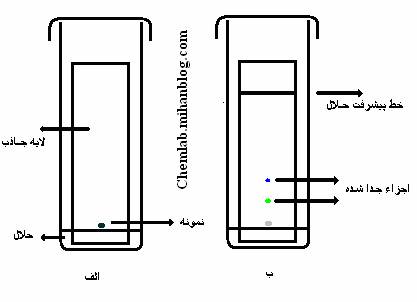
Application of Thin Film Chromatography :
Thin Film Thin Chromatography is the most widely used method in the pharmaceutical industry for all important measurements and the degree of purity of products.
Also, it has become widely used in clinical laboratories
The backbone of numerous studies in biology and biochemistry has been.
Finally, it has become widely used in chemical industry laboratories .
Comparison of thin layer chromatography with various chromatography
- Comparison with adsorption column chromatography : Chromatography of a typical absorption column is a slow process and requires a large amount of adsorbent and sample specimens.
- Recent advances in high-performance systems have definitely eliminated speed, scale, and identification problems. But these systems cost a lot and their device is very complicated.
- In thin-layer chromatography, only a small amount of absorbent and sample is needed, the device is simple and inexpensive.
Spots isolated on the screen are revealed like paper chromatography, therefore, it is usually not necessary to collect the components. - However, there are no drawbacks to the preliminary separations, and the separation of materials is done with increasing thickness of the layer or using a large number of samples.
- After separating the material, it is easy to obtain an object individually by dispensing and collecting that part of the layer where the object is absorbed.
- After this operation, the object can be extracted in an appropriate solvent.
- Comparison with paper chromatography: Thin layer method has a major advantage in speeding, in most cases, better material separation.
- The average time for solvent movement to 10 in thin film chromatography on silica gel is 30 - 20 minutes, while the same separation of materials on a fast paper may take 2 hours.
- The separation of materials better relates to the fact that adsorbent in thin-layer chromatography has a greater capacity than paper in paper chromatography.
- Therefore, isolated spots retain the shape and size of the original head in a relatively large amount, and diffusion does not depend on split chromatography on the thin-layer paper.
Column chromatography
In the column chromatography, the object is dispersed between liquid and solid phases. The stationary phase is a solid object, and this body selectively absorbs and separates the liquid components that pass through it. The effects that cause surface absorption are those that cause absorption in the molecules. These effects include electrostatic gravity, complex formation, hydrogen bonding, van der Waals force and so on.
To separate a mixture with column chromatography, fill the column with an active solid (solid phase) such as alumina or silica gel, and place some of the liquid sample on it. The sample is first absorbed at the top of the column. Then the extraction solvent flows through the column. This fluid phase moves the mixed components together. However, due to the selective gravity of the solid phase, the corresponding components can move down the pivot at different speeds. A compound that stays with the less absorbing phase of the phase will be removed faster because its molecular percentage is higher in the moving phase than the compound that stays with the higher absorption power of the phase.
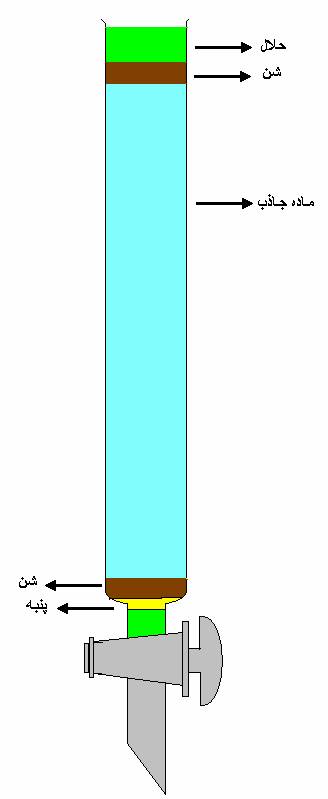
Separated components can be redefined in two ways:
1) Column solids can be removed and removed from the part containing the desired band and extracted with the appropriate solvent.
(2) Because the bands go out at different times, it is possible to pass enough solvent from the pillar to remove the bands from the bottom and place them in a separate container.
Usually the second method is more practical.
In the case of colored objects, you can see the bands that come down to the bottom of the column directly.
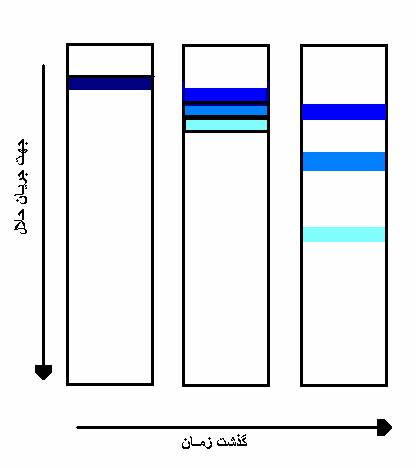
But in the case of bastards, changes can not be seen directly. However, many objects find ultraviolet fluorescence when exposed to light, and in such cases, this property is used to observe the bands. Column chromatography is used to collect small and fixed volumes (e.g., 25 ml) of the extracted solution to find out the flow of the column. Then the solvent evaporates to see if there is any physical in them. Although an object may be spread in a few containers, but if the volume of each component is relatively low (eg, less than 10% of the column volume), various gangways are collected in different containers. Another method to find the proper separation is that the solution extracted in a different time interval with thin layer chromatography should be investigated.
Paper Chromatography Film:
+ نوشته شده توسط فاطمه رجبی و مهرناز مرتضوی ها در یکشنبه سوم دی ۱۳۹۶ و ساعت 10:43 |
برچسب:
نویسنده: مانی افشاری